
 Charlie had long carried the feeling of being an outsider in a world that expected people to fit neatly into place. Growing up, he struggled to reconcile who he was with who he thought he was supposed to be.
Surrounded by homophobia and bullying, the pressure to conform weighed heavily. By the time he was thirteen, that weight felt almost unbearable.
Years later, in 2015, Charlie was walking down Capel Street when something caught his eye. A simple sign read Outhouse, and it stopped him in his tracks. At home, he looked it up online and discovered a community centre for LGBTQ+ people. It was not centred around bars or nightlife, but around connection and care. That difference mattered.
So Charlie took a quiet leap and signed up for the book club, feeling nervous but hopeful. “I wanted to be like everyone else. Straight. You know, what I thought was normal,” he says. “But since accepting myself and coming to Outhouse and meeting people like me, it’s made me think, ‘Well, what is normal?’”
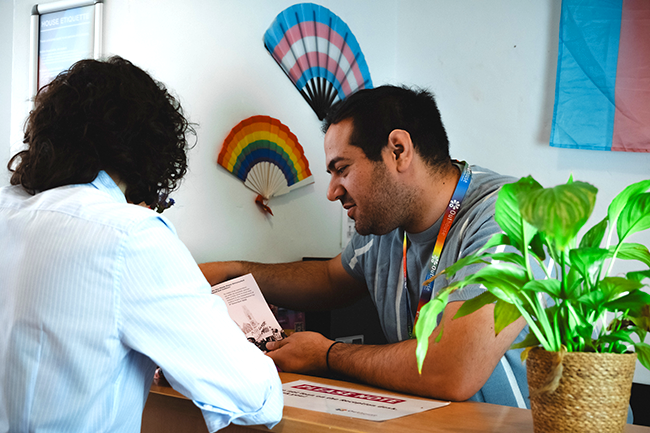
The first visit was filled with nerves. He walked through the doors unsure of what to expect, heart racing, bracing himself for rejection. Instead, he was met with warmth. Jamie greeted him at reception. There was no pressure or expectation, only kindness.
“Well, fear was the first emotion,” Charlie says. “Fear of the unknown. Fear of what the gay community is like. Fear of whether I would fit in or whether they would like me as a person.”
The book club gathered in a the small, cosy library. Charlie introduced himself softly, still holding back. Over time, he began to speak more freely. The group became a space where his voice felt welcome.
One book, in particular, stayed with him. Fun Home resonated deeply with its honesty and complexity. As a graphic designer, Charlie was drawn to the illustrations, but it was the story itself that mirrored his own journey of self-discovery.
Outhouse soon became more than a place to talk about books.
“I probably would have been too shy to go to any of the bars,” Charlie says. “So for me, Outhouse was an open door. It was a way to get to know the community and to interact with people who can relate to you.”
He joined the casual choir and discovered a love of singing he had not expected. The choir became a source of pride and connection. Outhouse began to feel like home.
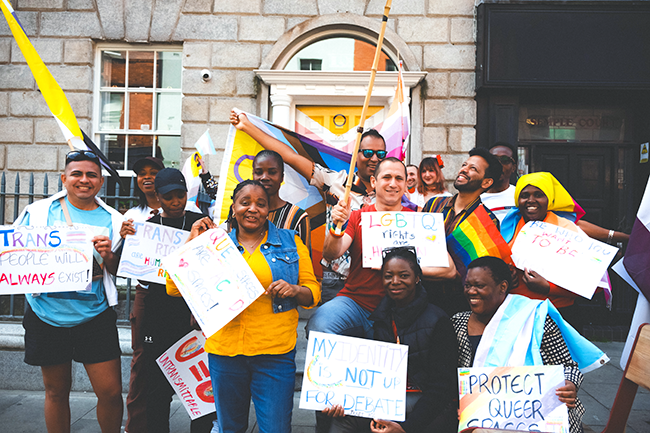 That sense of safety mattered deeply when Charlie was kicked out of home and found himself without a place to go. In that moment, the first place he went was Outhouse.
“I remember sitting at the window where the seats are, in tears,” he says. “I will never forget Leeanne and the staff. They sat with me and made me feel welcome. She gave me a coffee and tried to calm me down because I was still in shock.”
The moment stayed with him. Not only the crisis, but the care.
“It was just amazing,” he says.
The experience also changed how he saw the wider world. “I was shocked,” Charlie reflects. “The LGBTQ+ community are one of the most vulnerable when it comes to homelessness. Whether it is coming out and being kicked out, or coming from another country and having nowhere to go, it felt like the country has let down the community in that way.”
Still, Outhouse stood as a place of consistency and care.
As Charlie reflects on his journey, what stands out most is not one single moment, but the steady presence of Outhouse throughout it. It is the place where fear gives way to confidence, and where uncertainty is met with patience and care.
Outhouse did not change Charlie overnight. Instead, it offered something quieter and more enduring. It gave him space to grow, to connect, and to feel at ease in himself. Through the book club, the choir, and the everyday welcome he receives when he walks through the door, he has found community and belonging on his own terms.
“There’s no normal straight person. There’s no normal gay person,” he says. “We are all just who we are. Hopefully, we can be kind to other people and live our lives in a way that makes us happy.”
That sense of belonging carries forward. Charlie knows Outhouse is there, not just as a building on Capel Street, but as a constant in his life and a place he can return to when things feel uncertain.
For Charlie, Outhouse is proof that acceptance does not have to be dramatic to be life-changing. Sometimes, it is simply a door that stays open, a welcome that feels genuine, and a community that meets you where you are.
– – – – – – – – – – –
*This story is true. The name “Charlie” has been changed to protect the individual’s privacy.