
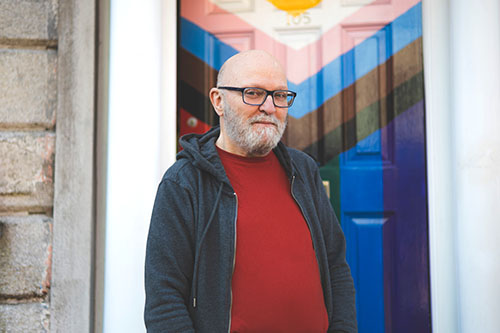
 Patrick doesn’t consider himself one of the “superstars” of Ireland’s LGBTQ+ rights movement—but he’s been there through it all. “I was never the one giving the big speech,” he says, “but I was always the bum in the seat. I showed up. That’s what mattered.”
Since the 1980s, Patrick hasplayed a quiet but steady role in shaping Ireland’s queer landscape. His work with Gay Community News (GCN) and the Dublin AIDS Alliance began at a time when being openly gay came with serious personal risk—and when HIV and AIDS were devastating the community.
Patrick trained in massage therapy to support those living with HIV and AIDS in hospitals like St. James’ and Cherry Orchard. “Back then,” he says, “just being willing to touch someone with care could be seen as political. That tells you something about the time we were living in.”
But Patrick’s contributions go beyond care work. In the 1990s, he was one of the voices inside the National Gay Federation pushing for broader inclusion—helping to usher in the name change to the National Lesbian and Gay Federation. He was a peer educator, a health advocate, and a contributor to the Irish AIDS Memorial Quilt. He didn’t always have the resources or the safety net that some others did, but he believed in taking part, however he could.
“I didn’t have the ability to be front and centre,” Patrick says. “But I believed in the cause. I was political with a small p. What I do is political—even if it’s just showing up, making space, being counted.”
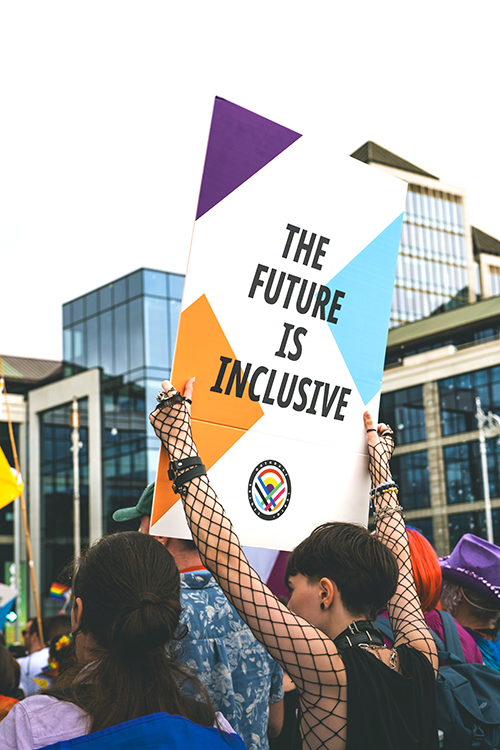
That sense of commitment—to people, to place, to presence—has carried through his decades of volunteering. He’s been with Outhouse LGBTQ+ Centre for 25 years, making him the organisation’s longest-serving volunteer. These days, he facilitates two of its most beloved social groups: Gold, for LGBTQ+ people aged 50 and up, and Men’s Night, a Friday evening drop-in.
“Outhouse has been a constant,” he says. “And it’s not just about support, it’s about friendship. Belonging. Having a place to be yourself—whether you’re 25 or 75.”
Looking back, Patrick is keenly aware that change hasn’t been linear. “It’s never a straight road. Some things move forward, others go back. But we’ve always kept going. That’s the bit I hope younger people hold onto—it’s not about feeling powerful all the time. It’s about not disappearing when things get hard.”
He doesn’t romanticise the struggle, nor does he underestimate today’s challenges. But Patrick believes that collective action—no matter how small—is what makes progress possible. “You don’t have to be a hero,” he says.
“Just show up. Back someone up. Sit in the room. Sometimes, that’s enough to help carry things forward.”
For Patrick, personal freedom and collective commitment go hand in hand. “I am what I am,” he says, “and I’ve always believed: if you want to be free, you’ve got to show up for others too. That’s the work. That’s what makes the difference.”