
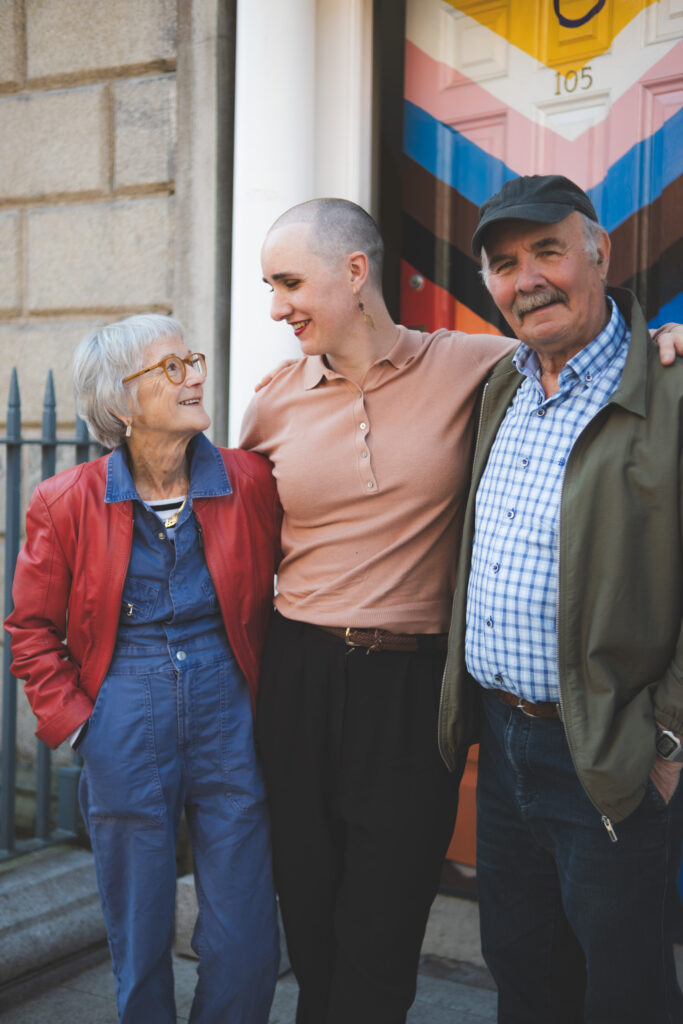
 When Annie came out as transgender, her parents, Pauline and Eugene, were loving—but understandably worried. “I just wanted her to be safe,” Pauline recalls. It wasn’t instant celebration, but it didn’t take long to get there. With time, a bit of learning, and a lot of love, their response became what it had always been at its core: unwavering support.
Now in her thirties, Annie reflects on that time with appreciation and perspective. “I was always just so accepted,” she says. Still, she’d carried fears with her—fears not shaped by her family, but by the world outside. “I think I was getting it from society and TV… The only time you saw a queer story on TV growing up was like, you come out and then you get thrown out of your house.”
Her reality, thankfully, unfolded differently. In a home with four children, two of whom are LGBTQ+, the family’s openness and capacity to adapt has become part of its everyday rhythm. Pauline and Eugene are quick to say they’re still learning. But they’ve never questioned the foundation: love, respect, and togetherness.
That acceptance wasn’t born from instant understanding, but rather from the values already embedded in the family. Eugene, her dad, nods to the shifts they’ve all gone through. “You adjust your thinking, you change,” he says, “and you do it because you love your children.”
The family is full of warmth and humour—comfortable, affectionate, often playful. There are inside jokes, shared glances, and references to jazz sessions where Eugene and Annie connect through music. “Annie and I get joy,” Eugene says, smiling, “trying our hand pretty simplistically at some jazz tunes.” He adds that Annie has strong and supportive relationships with each of her siblings—“it’s a close-knit bunch,” he says.
It’s a quiet kind of joy that pulses underneath their story—something steady and generous. Pauline reflects on this idea with sincerity. “I hear a lot about queer joy from Outhouse,” she says, referring to the LGBTQ+ centre where Annie works. “And I think it’s such a good way to put it. Because there’s so much focus on the struggles—and they are real—but there’s joy too.” She lights up when talking about her children. “Aoife’s met this gorgeous woman, absolutely lovely. And that’s joy for me—to have somebody like that in her family and ours.” She turns to Annie with a cheeky smile. “My joy, what I’m waiting on now, is for Annie to meet someone. No pressure!”
This joy doesn’t mean the family has ignored the real challenges trans people face. It’s part of what drove Pauline’s early fears when Annie came out. “I was scared,” she admits. “Scared of the world, of how people would treat her. But never of who she was.” It’s that distinction—between fear for someone and fear of them—that seems to define this family’s clarity.
There’s reflection, too. Pauline speaks about identity with an intuitive kind of acceptance. “All of us are on a long line anyway,” she says thoughtfully. “A spectrum. So why can’t gender be the same?” It’s a perspective that feels both simple and expansive.
And perhaps that’s the most radical thing of all—not just acceptance, but ease. A home where gender, identity, and love can coexist without condition. Where a family grows alongside each other. Where joy is not a surprise—but something expected, shared, and deeply felt